Custom ERP software: why it finally pays off for SMEs in the AI era
For years, custom-built management software was a luxury reserved for large enterprises. Artificial intelligence has rewritten the rules. And your competitors, meanwhile, are starting to figure it out.
- Published on
- 06/05/2026
- Reading Time
- 8 min
- Written by
- Francesco Vecchione
There's a conversation that plays out in hundreds of small and mid-sized businesses every month, and it goes something like this: "The management software we use isn't enough anymore, but we can't afford to build something custom." A few years ago, that statement made sense. Today, less and less.
The idea that ERP and management software has to be bought off-the-shelf and then awkwardly bent to fit your company is a holdover from an era when writing code was genuinely expensive. For decades the math worked like this: licensing cost less than dedicated development, so you bought a package, paid a consultant to configure it, and resigned yourself to its limits.
That math has changed. And with it, what it means for an SME to make the right software call.
Off-the-shelf software asks you to adapt to it. Custom software adapts to you.
What's actually changed (and why it matters)
Over the last two years, artificial intelligence has done something few people fully predicted: it has made software development dramatically faster and cheaper. Not because code writes itself — it doesn't, and probably won't anytime soon — but because a good development team, with the right AI tools, now ships in a week what used to take a month.
That shifts the economic break-even point. A custom management system that would have cost €80,000 five years ago can cost €25,000–€30,000 today. And maintenance — historically the heaviest hidden cost of custom — is following the same curve.
Data on AI adoption in Italian businesses captures this moment well. According to ISTAT, in 2025 16.4% of Italian companies with at least 10 employees use artificial intelligence technologies, up from 8.2% in 2024 and just 5% in 2023. Among SMEs the jump is even sharper: from 7.7% to 15.7% in a single year.
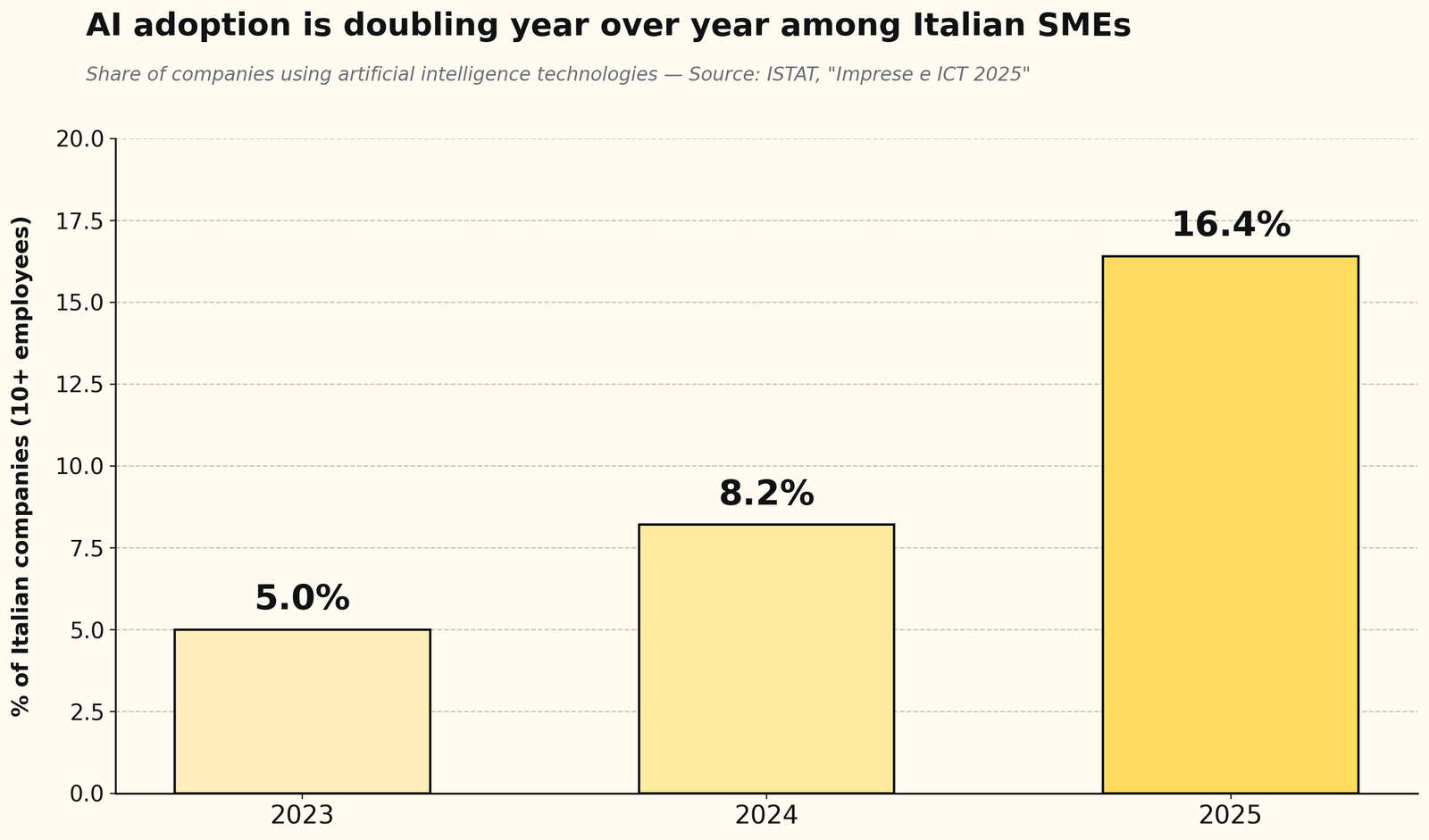
Original chart based on data from ISTAT, Imprese e ICT 2025 survey — reproducible with attribution
For software builders, the consequence is that the cost-to-time curve has compressed. For software buyers, the consequence is that "custom" has left the niche of large enterprises and entered the realm of the feasible for structured SMEs.
The real problem with off-the-shelf software
It's worth naming the hidden costs of packaged software, because anyone who hasn't lived through them tends to underestimate them.
Process adaptation. You buy a generalist ERP and discover that your specific order-approval flow doesn't exist. The vendor tells you that "you can handle it with the standard workflows," which don't actually cover your case. The result: you change your process to fit the software. That's the opposite of what should be happening.
Features you'll never use (and pay for anyway). Off-the-shelf ERPs justify their price with breadth. They have 200 modules because they have to speak to everyone: machine shops, law firms, pharmaceutical distributors. You'll use 12 of them. You're paying for licensing, training, and complexity for the other 188.
Integrations that turn into construction projects. You have an e-commerce store, a CRM, a warehouse system, an electronic invoicing tool. The generalist ERP promises "open APIs," but in practice every integration needs a consultant, a project, a budget. And every upstream software update threatens to break what you painstakingly stitched together.
Vendor lock-in. The least-discussed point and probably the heaviest. When your management system belongs to someone else, their development priorities aren't yours. If they decide tomorrow to raise the licensing fee by 40%, retire a module, or simply stop developing the version you use, you have no say. Your only choice is to absorb it or migrate. And migrating an ERP is one of the most painful projects a company can run.
When the software belongs to someone else, their development priorities are not yours.
What AI baked into your processes unlocks
This is where the conversation gets interesting for anyone thinking medium-term. A custom-built management system today can natively integrate AI components that off-the-shelf packages will catch up to in two or three years, and even then they'll arrive generic — not tuned to your business.
We're talking about concrete things: a system that forecasts replenishment orders based on your historical sales data, not a generic model. A conversational assistant that answers customer emails by drawing from your procedures, your price lists, your commercial terms. Automatic document recognition that fills in the management system's fields in place of an operator — on your documents, with your naming conventions.
These are all scenarios where the value isn't in the algorithm itself, but in the fact that it's stitched onto your reality. The Politecnico di Milano Observatories find that companies running management systems aligned with their actual processes report concrete gains: 83% greater process control, 80% reduction in operational errors, 79% better visibility on operational workflows.
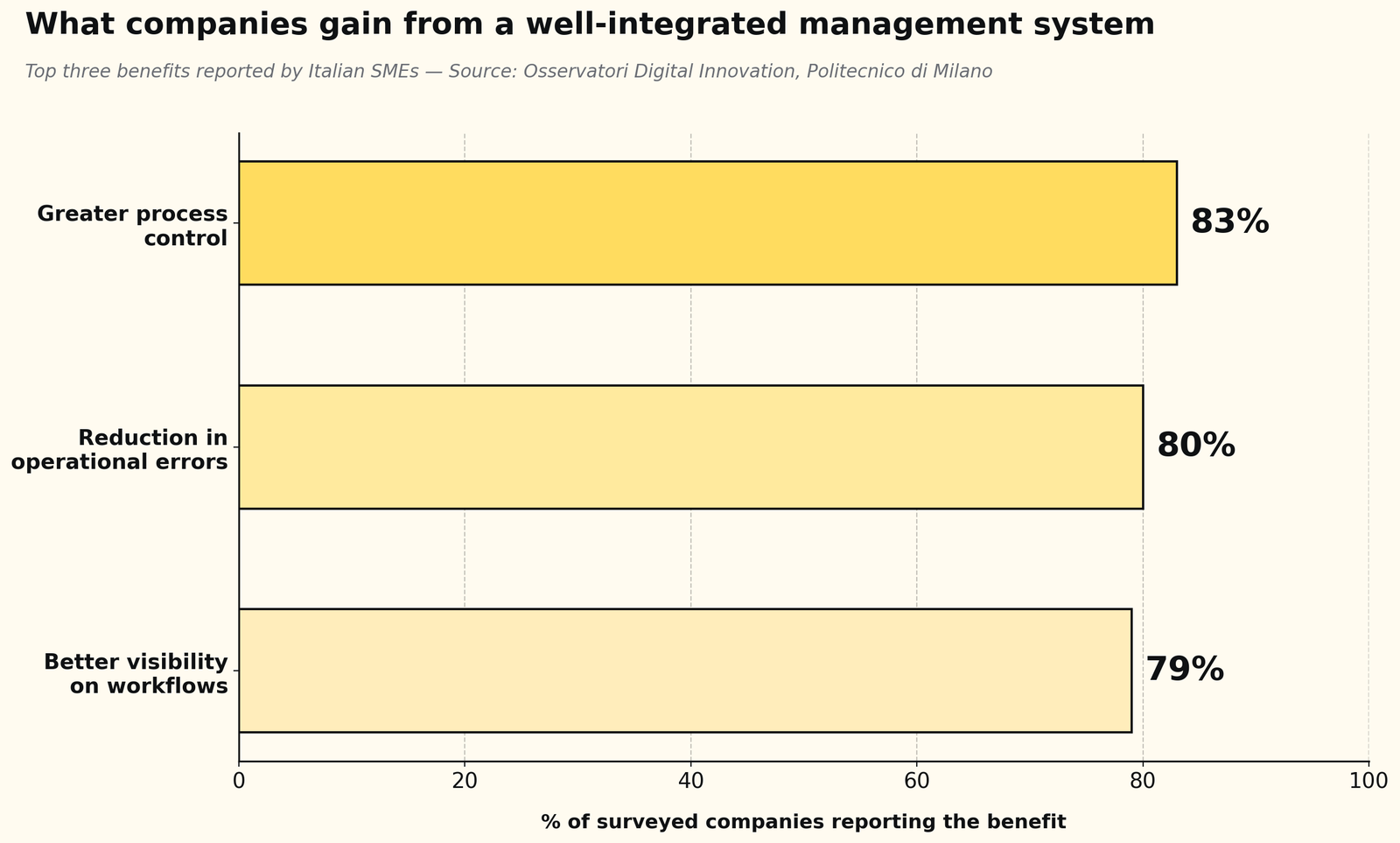
Original chart based on data from Osservatori Digital Innovation, Politecnico di Milano — reproducible with attribution
The Italian paradox
The numbers on Italian SMEs tell a two-sided story. On one hand, awareness is growing: 54% of SMEs say they're investing decisively in digital. On the other, only 19% are adopting advanced technologies in a structural way. And 59% report a shortage of specialized in-house talent.
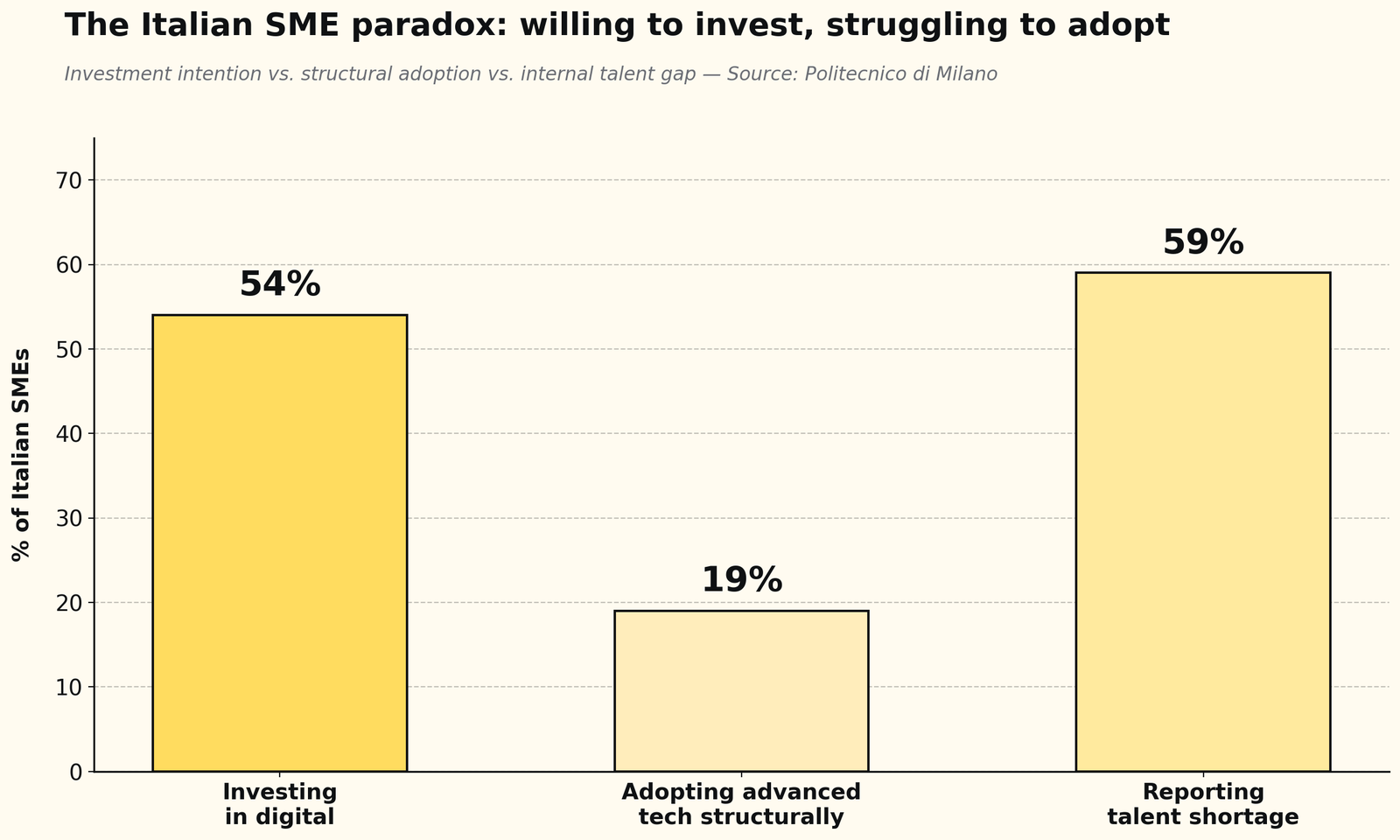
Original chart based on data from Osservatorio Innovazione Digitale nelle PMI, Politecnico di Milano — reproducible with attribution
Translation: the willingness is there, the budgets are there, but the capacity to turn technology investment into something that actually works inside the company is not. That's exactly the point at which off-the-shelf ERP fails and custom-built ERP wins. Not because the latter is more technologically advanced — often it isn't — but because it speaks the language of your processes.
54% of SMEs invest in digital. Only 19% manage to actually use it.
When custom DOES NOT make sense
It would be dishonest to pretend custom development is the right answer every time. It isn't. There are cases where a packaged product remains the better call, and they're worth naming clearly.
When your processes are genuinely standard. If you run a small operation whose workflows match those of ten thousand identical companies, a generalist ERP will do the job. Paying for custom in that case is, honestly, a waste of money.
When the business is still searching for its shape. If you're a startup that pivots its business model every six months, or a company exploring a new market without firm answers, freezing your processes into dedicated software is premature. Better to use something flexible and generic, and replace it once you have clarity.
When you don't have anyone inside the company who can articulate what you do. A custom management system is born from a serious dialogue between the people who build software and the people who actually run the processes. If no one inside the company is willing to sit down and explain how things really work, custom becomes a disaster: the software will do what the developer imagines, not what you actually need.
Outside of these cases — and they're the minority today, for any structured SME — the conversation is different.
The bottom line
ERP software is not your company's clothing. It's the nervous system of the way your company operates every day: how you take orders, how you manage inventory, how you invoice, how you talk to customers, how you make decisions. Outsourcing that to a generic tool, designed for no one in particular, was an acceptable concession only as long as dedicated development was prohibitively expensive.
Artificial intelligence has changed the numbers. What used to be a large-enterprise investment is now within reach of a structured SME, and it produces a competitive advantage that off-the-shelf software, by definition, cannot deliver: a company whose processes and data work together, inside a system that understands how you work.
The uncomfortable fact is that your competitors, in the meantime, are figuring it out. And every month you spend bending yourself to your management system is a month someone else is bending their management system to themselves.