How Mokap works: the problem first, then the software
Good software doesn’t start with a feature list. It starts with understanding people, processes, and what actually needs to work better.
- Published on
- 2 Nov 2026
- Reading time
- 4 min
- Written by
- Francesco Vecchione
“We need a new management system.”
“We need to rebuild our platform.”
“We’d like to automate this process.”
“What if we used AI?”
These are all reasonable starting points for a software project. But they share one thing: they already suggest a solution.
The question is whether that solution is really the right one.
At Mokap, we prefer to start by asking a few more questions. Not to complicate the project, but to avoid building something that adds complexity instead of removing it.
The initial request isn’t always the real problem
Imagine a company that wants to replace its management system because certain tasks take too long.
A closer look might reveal that the system itself works, but doesn’t connect to other tools. People copy information between emails and spreadsheets, enter the same data more than once, and rely on manual workarounds for exceptions.
Does the company really need a new system? Maybe. Or perhaps a few integrations, a redesigned interface, or a focused internal tool would be enough.
To find out, we need to understand who uses the software, how they work today, where they lose time, and what gets in their way.
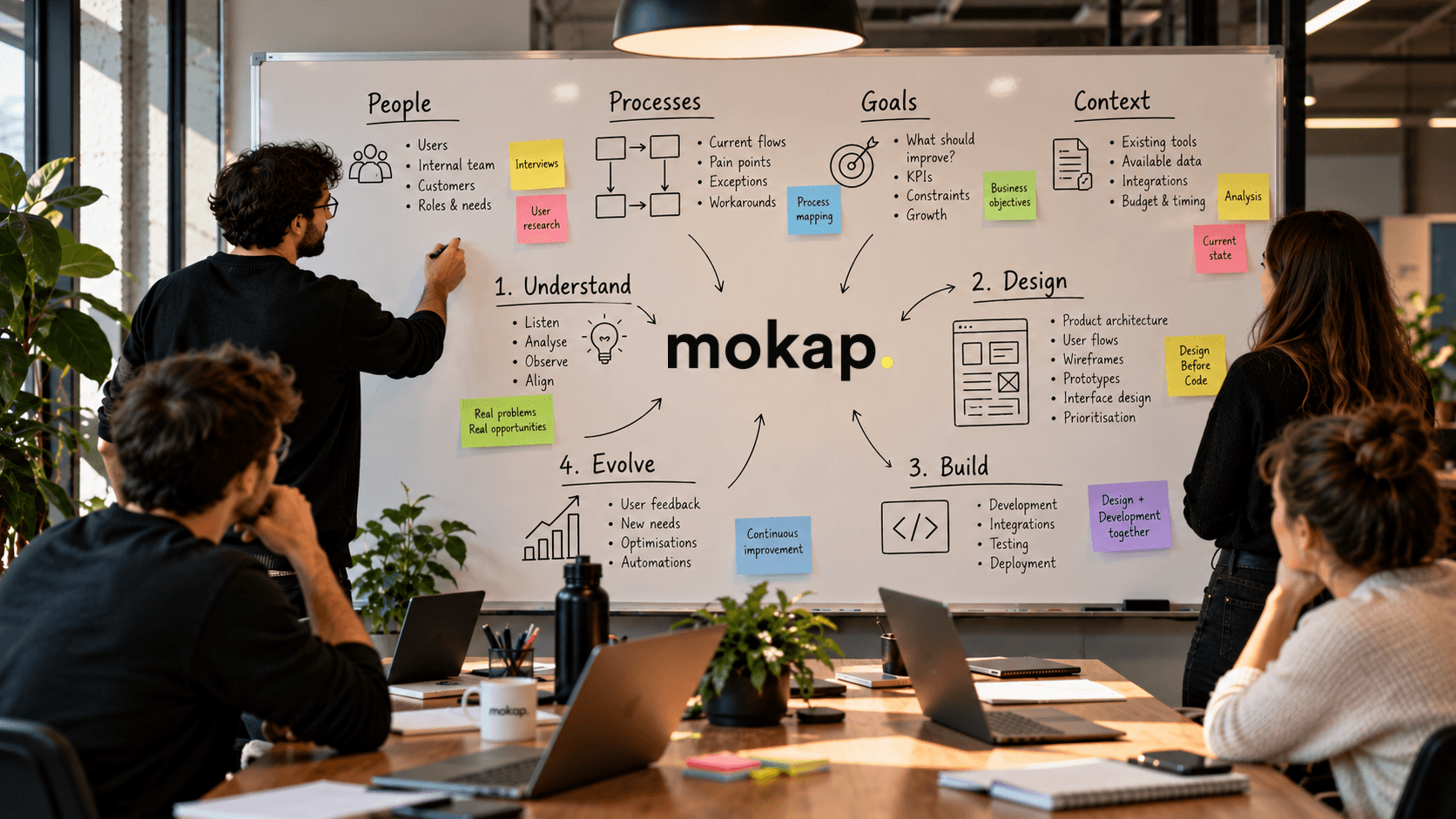
That’s what we mean by Understanding Before Building.
We don’t just ask what you want to build. We try to understand what needs to work better.
Understanding means looking at the work itself
We begin by getting a clear picture of the context.
We speak to the people involved, examine workflows, look at existing tools, and identify repetitive steps, errors, and points of friction.
We pay particular attention to exceptions.
A process may sound straightforward in a meeting but work very differently in practice. Someone handles unusual requests outside the system. Someone maintains a separate spreadsheet. Someone else knows an undocumented procedure that keeps everything running.
These details matter. They often reveal where a product falls short.
We also consider business goals, available data, technical constraints, and budget.
The outcome isn’t simply a feature list. It’s a shared understanding of the problem and the priorities.
Moving fast is useful. But if we misunderstand the problem, we may just build the wrong solution faster.
Design isn’t about making software look good
Once we understand the context, we start shaping the solution.
This is where Product Design and UX/UI Design come in.
We define the product architecture, organize information, map user flows, and identify the features that matter. Then we turn those decisions into wireframes, prototypes, and interfaces.
It’s not simply about choosing colors or placing buttons.
Design is first and foremost about deciding how a product should work.
If a manager needs to approve dozens of requests every day, a list with an “Approve” button isn’t enough.
We need to know what information supports each decision, which requests deserve attention, and what happens when something doesn’t go as expected.
That’s the idea behind Design Before Code and Clarity by Design: clarity isn’t added at the end. It shapes the product from the beginning.
Validate before you develop
A prototype lets us see and discuss a product before it’s fully built.
We can simulate tasks, review flows with the people who will use the tool, and spot unnecessary features, confusing steps, or missing requirements.
It’s also a chance to uncover misunderstandings between the people involved in the project.
Changing a flow in a prototype is generally easier and less expensive than changing it once code, databases, and integrations are already involved.
We can’t predict everything. But clarifying important decisions early helps reduce errors, changes, and rework.
Building: design and development work together
In many projects, design is treated as a separate activity: someone designs screens, hands over a Figma file, and someone else turns it into code.
At Mokap, we work differently.
We’re a Software Design Company. Product Design, UX/UI Design, and Software Development are part of the same process.
Designers and developers collaborate from the earliest decisions.
A technical constraint can affect how an interface works. A design decision can simplify development. Something discovered during implementation can suggest a better way to structure a workflow.
We don’t treat a design file as untouchable, or code as merely following instructions.
Design and development are different disciplines working on the same problem.
That approach guides our custom software development: building products around real business processes while considering usability, technical feasibility, and long-term sustainability together.
Complexity has to earn its place
It’s easy to add one more thing to a product.
Another filter. Another automation. Another screen. A feature that might come in handy someday.
But every addition comes with complexity: it must be designed, developed, maintained, and understood by the people using it.
So we ask whether a feature creates enough value to justify what it adds.
That’s our principle of Complexity Must Earn Its Place.
It doesn’t mean removing important features to make a product look minimal. Some business processes really are complex.
It means distinguishing necessary complexity from unnecessary complexity.
Sometimes the best choice isn’t another feature, but one fewer step or an automated repetitive task.
Simplicity doesn’t mean doing less. It means making what matters easier to do.
Technology follows the problem
Languages, frameworks, infrastructure, and integrations are important choices. They affect performance, security, maintenance, and a product’s ability to evolve.
But they should be chosen to serve the product, not the other way around.
The same goes for artificial intelligence.
Not every process needs AI. Sometimes clear rules, organized data, or a conventional automation are enough. In other cases, AI can offer real benefits.
The question isn’t which technology we can use. It’s which technology actually helps solve the problem.
Evolving means continuing to improve
Launch isn’t the end of a product. It’s when the software starts meeting the realities of everyday work.
People use it, new needs emerge, and priorities change.
We can see which tasks still take too long, where errors happen, and which parts of the product need improvement.
But evolution doesn’t mean endlessly adding features.
Sometimes it means simplifying what’s already there, improving performance, or redesigning a workflow.
The goal stays the same: helping people work better.
The problem first. Then the software.
When a company decides to build custom software, it’s natural to focus on features, timelines, and technology.
Those things matter. But there’s an earlier question: do we really understand what needs to change?
That’s where we start at Mokap.
We understand the problem, design the solution, build it with design and development working together, and improve it based on what we learn from real use.
It isn’t a rigid formula. It’s simply how we believe good software should be built.
People first. Processes first. Understanding first.
Then the code.