Brand identity for SMBs: why it's not a luxury reserved for big companies
The idea that brand identity is something for Apple, Coca-Cola and dizzying budgets sustains a costly misconception. For an SMB or a B2B company, it's exactly the opposite: it's the most underused lever on margin.
- Published on
- 14/05/2026
- Reading Time
- 9 min
- Written by
- Flaviano Arbia
There's a sentence you hear often in mid-sized companies, and it goes more or less like this: "we'll do the branding when we're bigger." Said with the confidence of someone making a rational decision: first we grow, then we worry about identity. First the revenue, then the logo. First the customers, then the "how we tell our story."
It's a line of reasoning that has its apparent logic, and that is almost always the reason the company isn't growing fast enough. Because it treats brand identity as an outfit to put on once you've made it to the living room, instead of what it actually is: the operating system through which a company gets recognised, remembered and chosen. And SMBs, which have smaller marketing budgets than the big brands, are precisely the ones that depend on that operating system the most.
The paradox is that large companies can afford to be mediocre at brand identity. They have advertising hammering away, distribution channels guarding the shelves, enterprise contracts already signed. An SMB doesn't. An SMB has few touchpoints with the customer, and each of those touchpoints has to do double the positioning work.
For an SMB, brand identity isn't decoration: it's how you compensate for not being able to spend like a giant.
What brand identity actually is (and isn't)
First things first: let's define the object. Brand identity is not the logo. The logo is one component. Brand identity is the coherent system of signals — visual, verbal, experiential — through which a company communicates who it is, what it promises, and why it deserves trust. It includes tone of voice, typography, colour palette, photographic style, the way you answer the phone, the packaging, the look of an invoice. All of it.
When the annual Interbrand report assigns a brand a monetary value — Apple over 500 billion dollars, to give a sense of scale — it isn't valuing the apple logo. It's valuing the aggregate of decisions that, over time, made that brand recognisable and desired. It's a financial valuation, made with the same logic used to value a patent or a licence.
The most common mistake in SMBs is conflating brand identity with marketing materials. Brand identity is the grammar. Materials are the sentences you produce with that grammar. Without the grammar, every sentence sounds like it was written by a different person — which is exactly the impression given by a company that hasn't worked on its identity: a patchwork of choices made at different times by different people, with the result that the website doesn't sound like the brochure, and the brochure doesn't look like it belongs to the same brand as the LinkedIn page.
Consistency as a revenue multiplier
The most uncomfortable data point for those who think branding is a cosmetic cost comes from the Marq report on brand consistency. Companies that present their brand consistently across all channels report an average revenue increase of 33% compared to those that do it in a fragmented way.
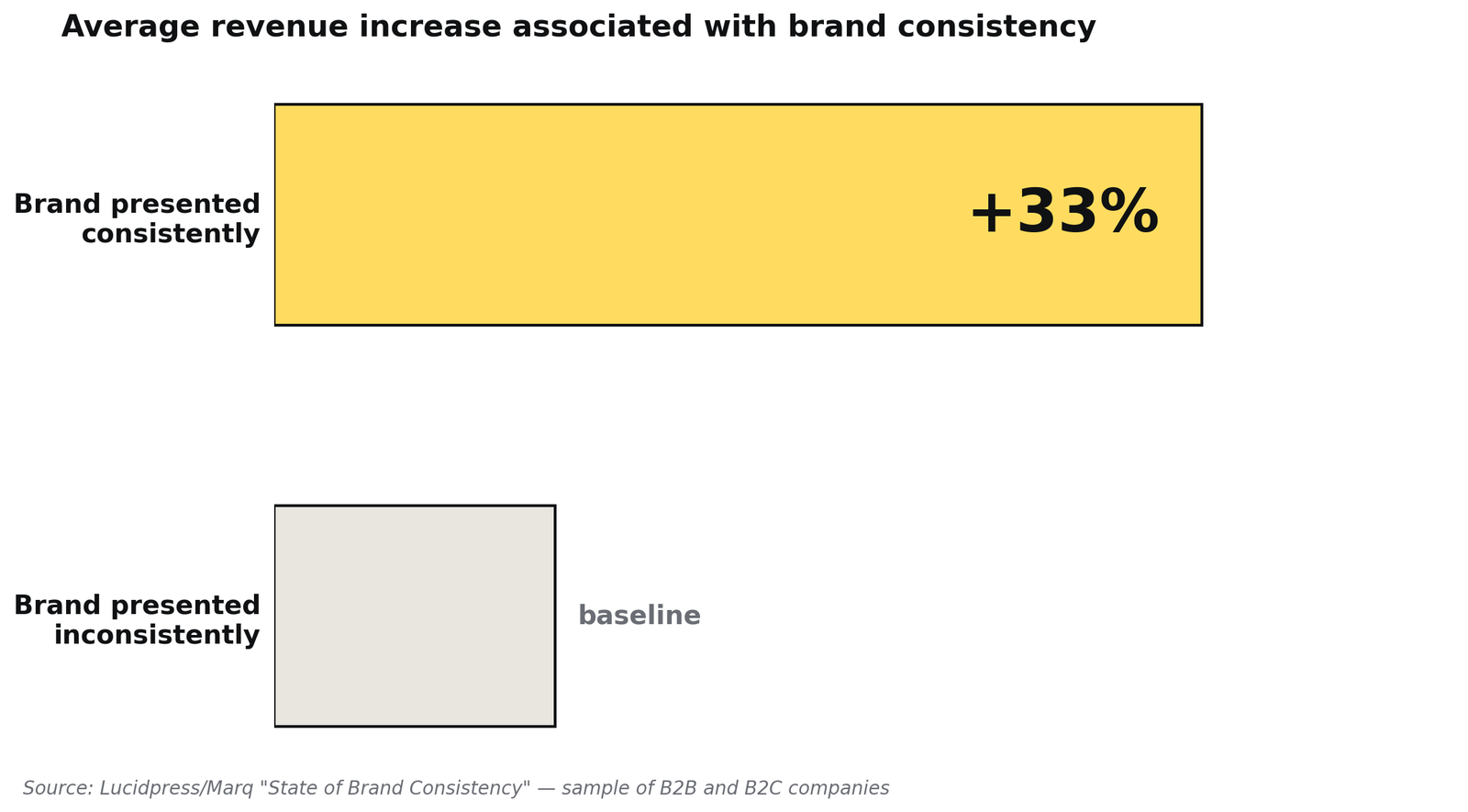
Original chart based on data from Marq — State of Brand Consistency — reproducible with attribution
It's not a trivial finding, and it's important to read it correctly. It is not saying that whoever has a prettier logo sells more. It's saying that whoever presents a consistent brand — same palette, same tone, same key messages, same perceived quality — across website, social, email, sales materials, customer service, gets a measurable revenue increase in return. The mechanism is clear: every consistent exposure to the brand reinforces recognition. Every fragmented exposure dilutes it.
For an SMB or a B2B company this means something very practical: every email from the sales rep, every quote, every employee's LinkedIn profile, every blog post is a touchpoint that either builds brand equity or burns it. There's no neutral third option. And in SMBs those touchpoints are few: the margin for error is razor-thin.
Why B2B struggles to see it
There's a remarkably persistent mythology in B2B that says: "our customers buy on technical specs, not perception." It's a reassuring idea for those who sell complex products and have invested years in expertise. Too bad it's contradicted by virtually all the serious research on the topic.
The most cited study, conducted by Google and CEB, showed that B2B buyers are significantly more emotionally connected to the brands they buy than consumers are. The reason is simple once you think about it: the consumer who picks the wrong toothpaste loses three euros. The B2B buyer who picks the wrong vendor loses the promotion, the internal reputation, in some cases the job. The B2B decision is more emotionally loaded, not less. And the brand is precisely the tool that reduces that risk perception.
When a buyer has to choose between two vendors with similar technical specs, they're making — even if they don't admit it — a perceived-reliability calculation. Which of the two looks like they know what they're doing? Which of the two, if things go wrong, will make me look less foolish in front of my boss? That calculation gets made in thirty seconds, on the website, on the materials received, on the LinkedIn page. It gets made on brand identity.
The B2B buyer doesn't pick the best vendor: they pick the one that will make them look least foolish if something goes wrong.
The cost of not having one
An SMB without a coherent brand identity pays in ways that rarely make it into budget meetings, because they're diluted across ten different line items.
It pays in customer acquisition cost. Without a recognisable identity, every euro spent on advertising starts from zero. There's no compounding effect. Campaigns don't leverage brand memory because that memory hasn't been formed. You end up paying full market price for traffic, while competitors with stronger brands pay less for the same clicks.
It pays in longer sales cycles. In B2B, a significant portion of sales work consists of reassuring the prospect that the company is serious, capable, and durable. A solid brand identity does that work before the salesperson even opens their mouth. A weak brand identity forces the salesperson to rebuild credibility from scratch every time, with calls, meetings, presentations. Time that is money, very literally.
It pays in pricing power. The principle is well documented in the marketing literature: brands perceived as more recognisable and reliable can sustain higher prices without losing demand. For an SMB, this means the difference between competing on price — a game you only win if you're the largest — and competing on perceived value, which is a game open to small players too.
It pays in talent. The best candidates choose where to go partly based on how the company presents itself. A confused brand identity signals — rightly or not — a confused company. And in the post-2020 labour market, where people choose where to take their skills, this is a cost SMBs systematically underestimate.
What SMBs that get it actually do
Mid-sized and small companies that have treated brand identity as a structural investment — not as a one-off graphic project — share a few recognisable habits.
They start from positioning, not the logo. First they decide who they are for whom: which customers they make sense for, which alternatives they compete against, which promise they make and keep. The visual system comes after, as a translation of that choice. Doing it the other way round — starting with the logo — produces beautiful, generic identities that don't help the customer understand why they should choose you.
They document brand identity and make it operational. They have a brand book, even a minimal one, that lets the salesperson, the freelance designer, the new employee produce coherent things without having to ask every time. Without documentation, brand identity lives only in the founder's head and gets diluted with every new hire.
They apply it in invisible touchpoints. Not just on the website and on social, but in automated emails, invoices, employee signatures, calendar invites, quote templates. Those touchpoints account for 80% of the times a customer sees the brand. Neglecting them means working on your positioning only 20% of the time.
They measure recognition, not just sales. They track brand search (how many people search the company name directly on Google), direct traffic, unsolicited mentions. They're less direct than revenue metrics, but they're the sensors that tell you whether brand equity is growing or not.
The point
When a founder says "we'll do the brand identity later, first we have to grow", what they're really saying is: "I'll keep paying full price for every customer, while my competitors pay less." It's not a prudent financial choice. It's a choice of voluntary taxation: every month that goes by without a coherent identity, the company leaves margin on the table that it won't recover.
The good news is that brand identity isn't a cost that scales with size. Building it well for an SMB doing five million in revenue doesn't cost five times less than for a company doing twenty-five: proportionally, it costs much less. And it's one of the very few items in marketing spend that, done seriously once, keeps producing returns for years without further investment.
The most uncomfortable data point, going back to the opening figure, is that the 33% average growth doesn't get distributed evenly across the market. It goes to the companies that have decided to take it, and is subtracted from the others. SMBs that today think they can't afford brand identity will, in five years, find themselves competing with rivals that did afford it — and that by then will have a compounded advantage that no advertising campaign recovers.
It's not a question of aesthetics. It's a question of which share of the next ten years' revenue is actually yours, and how much of it you're handing over, every month, to those who figured out before you that branding wasn't optional.