Why a React + Django stack is a strategic choice, not just a technical one
When you choose what to build your digital product on, you're not just picking a language. You're deciding how much freedom you'll have over the next five years.
- Published on
- 18/05/2026
- Reading Time
- 9 min
- Written by
- Francesco Vecchione
The question "what tech should we use?" sounds like a developer concern. But it's one of the most strategic decisions a company makes when investing in a custom digital product. It determines how quickly you can grow, how easily you can switch vendors, and what your software will be worth in five years.
This article won't dive into the technical details of React and Django — there are thousands of guides for that. We'll talk about the strategic advantages of building on this stack today, and what changes when you compare it to the alternatives.
React is the most widely used JavaScript library in the world for building web interfaces. Maintained by Meta and a massive community, it's the de facto standard for the front-end of modern applications. Django is a mature Python framework (almost 20 years old), built for creating robust, secure, scalable back-ends quickly. Together they form a stack that cleanly separates presentation from business logic — an architectural choice with direct strategic consequences.
You can switch vendors. Really.
This is the most underestimated advantage, and the one that pays off the most in the medium term. When your product is built on React and Django — both open source, free, with permissive licenses — the code is yours. No vendor can "switch off" your software or hike its price 40% because they changed their commercial strategy.
But there's more: the technology standard is so widespread that you can change your development team without rewriting anything. If your current vendor isn't working out, a new agency or an internal team can pick up the project, read it, understand it, and carry it forward. This is the exact opposite of what happens with proprietary or niche technologies, where the original vendor holds you hostage by definition.
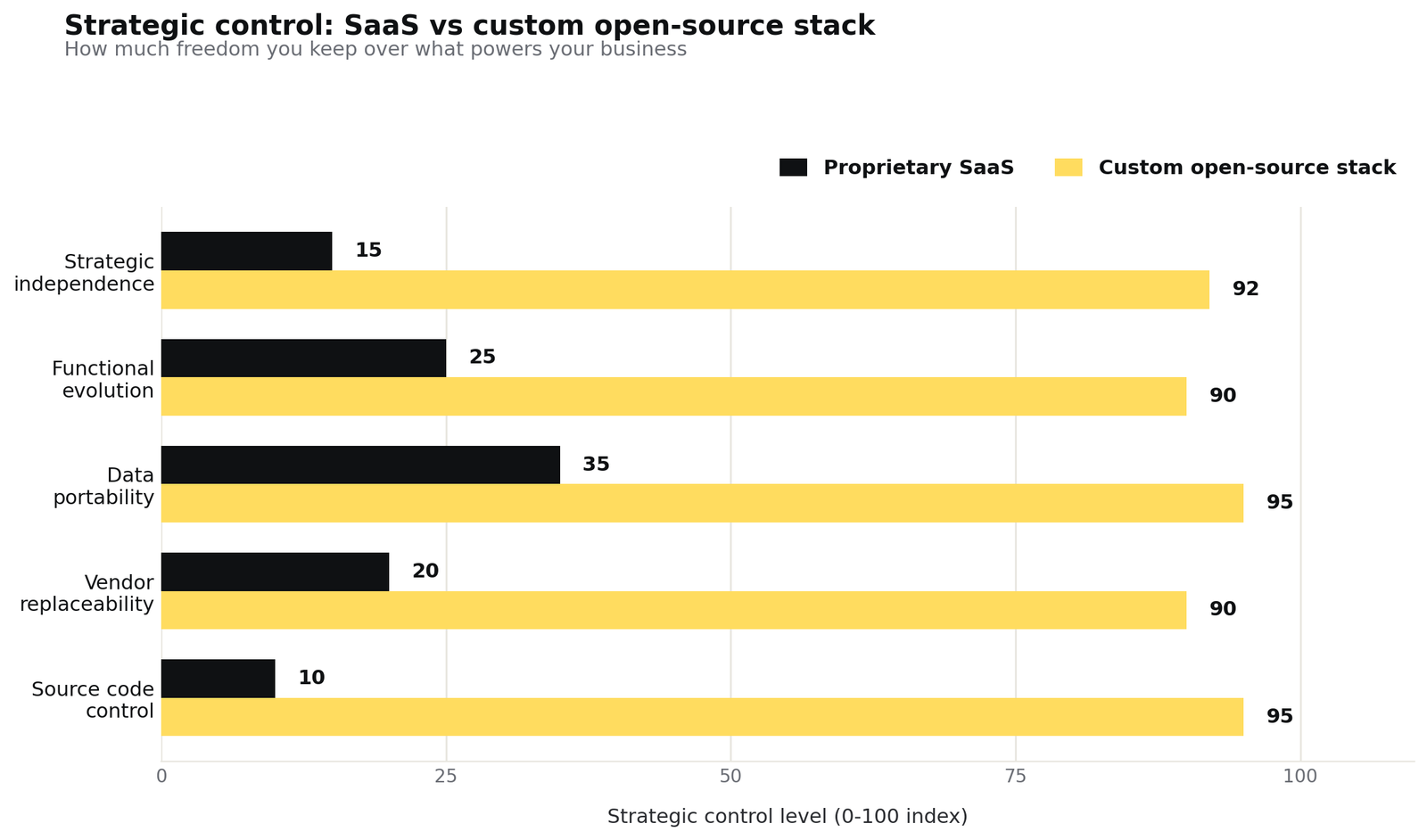
Qualitative estimate based on the proprietary vs open-source nature of the two options
If you can't switch vendors without throwing the software away, you don't really own your software.
You can find developers anywhere (at sane costs)
Talent is the most concrete constraint on software projects. A niche technology forces you to pay 30-50% premiums on market salaries and leaves you exposed: if your only senior developer leaves, the project stalls.
JavaScript and Python are the two most widely used languages in the world. React is the most adopted front-end library. This means that the pool of available developers — freelancers, agencies, employees — is huge. In practice: more candidates, shorter hiring times, lower costs, lower risk of running out of skills.
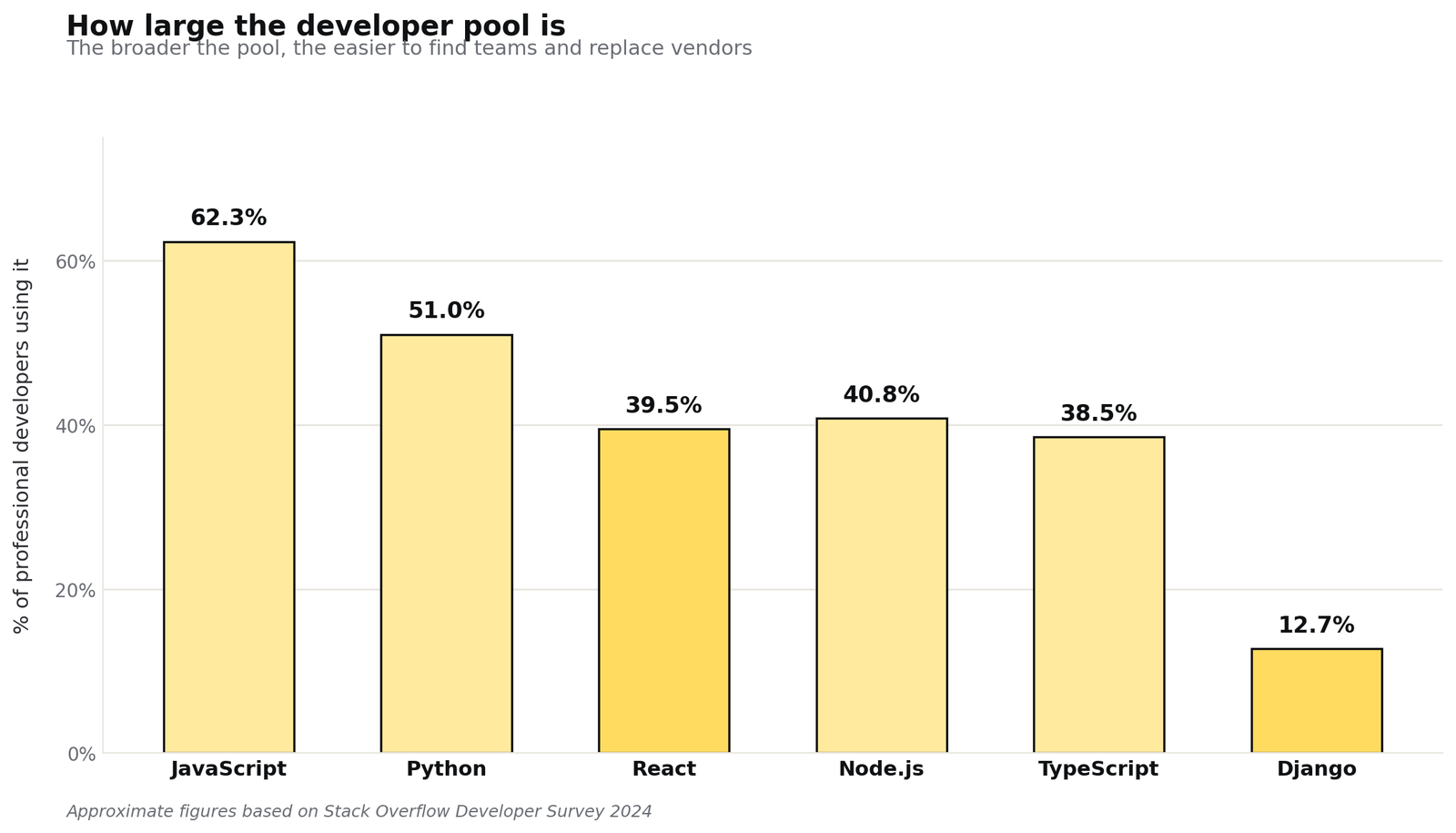
The wider the developer base, the easier it is to scale a team or replace a vendor
A decoupled architecture protects you from the future
React and Django typically communicate via REST (or GraphQL) APIs. This means something very concrete: front-end and back-end are two separate worlds that talk to each other through a clean interface.
Strategic consequences: tomorrow you might want to add a mobile app? It plugs into the same APIs. You need a customer portal separate from your internal app? Same APIs. Want to swap the front-end for a more modern technology in three years without touching the business logic? You can do that without rewriting the database and the workflows. It's optionality built into the architecture.
The same is true in reverse: if one day you wanted to replace Django with a different back-end (rare but possible), the React front-end wouldn't notice anything, as long as the APIs stay compatible.
Python opens the door to data, AI, and automation
This is the least visible advantage at decision time, but the one that pays off the most over time. Python isn't just the language of Django: it's the reference language for data science, machine learning, and AI. Pandas, NumPy, scikit-learn, PyTorch, TensorFlow, the libraries from OpenAI, Anthropic, and Hugging Face — they all have Python as a first-class citizen.
Practical consequence: if tomorrow you want to add a predictive model, a recommendation system, a document classifier, an intelligent chatbot, or any AI capability to your product, you're already in the same ecosystem. You don't need to switch languages, maintain two teams, integrate different systems: you just add a library to your back-end.
For anyone building a digital product that has to evolve over the next five years — and the next five years will be defined by AI — this is a non-negotiable feature.
Maturity: no surprises, no rewrites
Django has existed since 2005. React since 2013. We're talking about technologies that have survived economic cycles, tech fads, acquisitions, and leadership changes. The world's largest companies use them in production: Instagram, Spotify, Pinterest, Mozilla, Dropbox, The Washington Post, and thousands of smaller players.
Technological maturity translates into three concrete things for anyone investing: vast documentation (any problem you face has already been solved by someone), a rich ecosystem of ready-made libraries (payments, authentication, dashboards, file management, integrations), and code stability over time. A Django app written five years ago, with reasonable maintenance, still runs today without trauma. Hype-driven technologies rarely can say the same.
Zero license costs, predictable scaling costs
Neither React nor Django costs anything in licenses. Zero. Forever. What you pay for is development (once) and the cloud infrastructure the application runs on (monthly, but scaled to actual loads).
Compare this with the typical SaaS curve: per-user pricing that grows, feature gating that pushes you to higher tiers, 10-20% annual increases, costs that explode at scale. With an open-source stack, company size doesn't affect the cost of the software itself — only the cost of infrastructure, which grows in predictable, optimizable ways.
What about the alternatives?
React + Django is a solid choice, but not the only one. It's worth knowing its competitors so you understand when one of them might be a better fit.
React + Node.js (with Express, NestJS, or Fastify) is probably the most direct alternative. Same front-end, but JavaScript back-end. Upside: a single language across the whole stack, great for small teams and real-time applications (chat, live collaboration, streaming dashboards). Downside: a much weaker AI/data ecosystem compared to Python.
Next.js is a full-stack framework based on React that has become extremely popular. It combines a front-end with a "lightweight" back-end portion. Excellent for modern SaaS products and sites that need to be fast and SEO-friendly. Less suited if your back-end logic is complex or data-heavy.
Vue + Laravel (PHP) is a combination heavily used in Italy and Europe, especially among SMBs. Gentle learning curve, fast development, great value for business apps and MVPs. Smaller developer pool compared to JavaScript/Python.
.NET + Blazor is the typical choice of large companies in Microsoft contexts. Robust, well integrated with the enterprise ecosystem, license costs eliminated in recent years. More rigid and with a developer pool oriented to the enterprise world.
Low-code (Bubble, Retool, Glide, Webflow): these aren't true development stacks, but platforms that let you build apps without writing code. Very fast for MVPs and internal tools. The price you pay is vendor lock-in: you go right back to the problem people choose custom products to escape from — you're tied to a proprietary vendor, you don't really own the software.
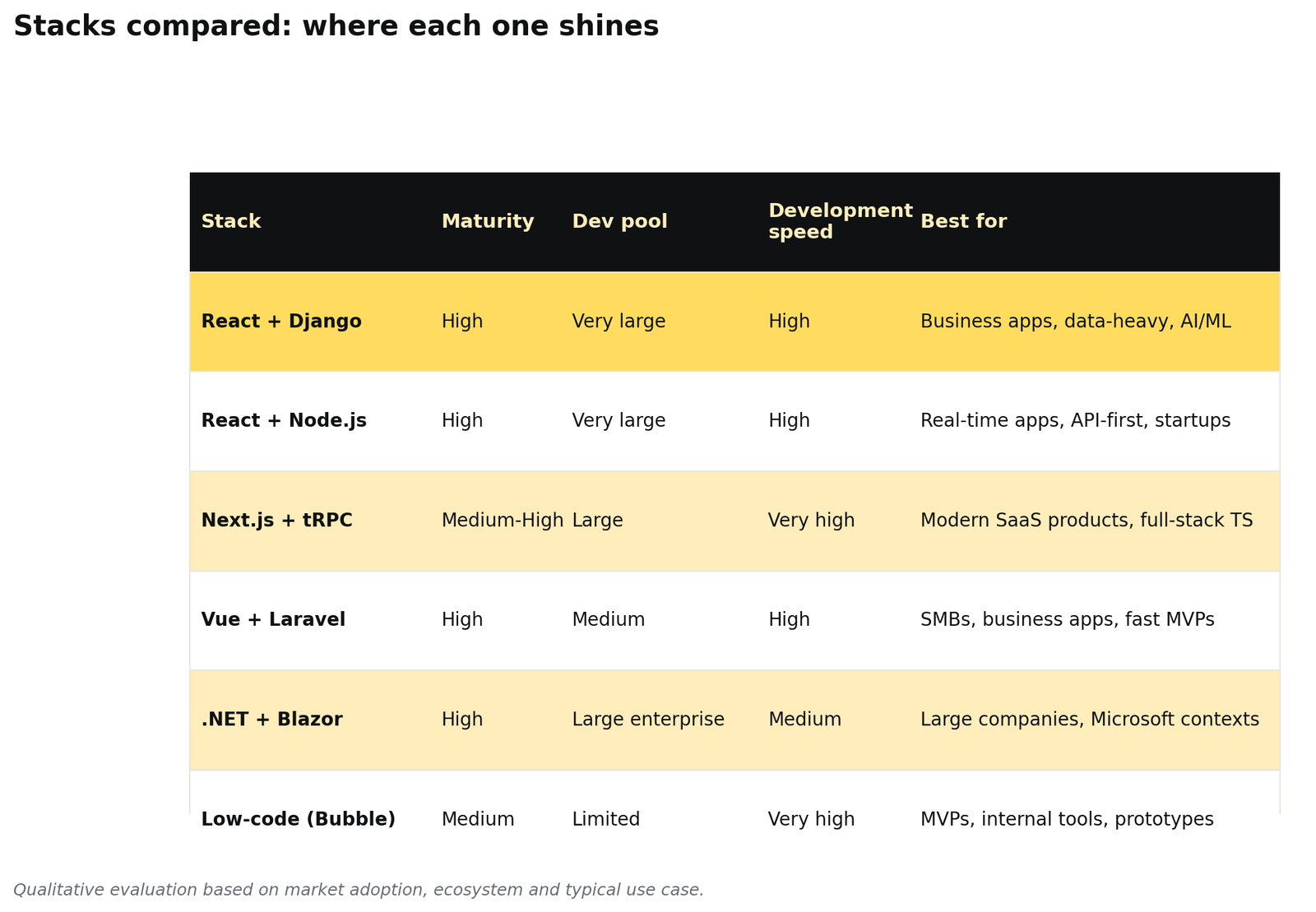
Summary of the main stacks compared on the most relevant decision criteria
When React + Django is the right choice
There's no universally best stack — there's a stack that's right for your problem. React + Django shines especially when at least one of these conditions is met:
You're building a business or data-heavy web app, where business logic is rich and data is the heart of the product. You expect to integrate AI or advanced data analytics in the coming years. You want a product built to last, with sustainable maintenance and interchangeable teams. You need vendor independence as a strategic requirement, not as a theoretical wish. You're designing an architecture that has to evolve, perhaps by adding mobile apps, customer portals, or B2B integrations.
If instead your need is an MVP to validate in three weeks, a marketing site, a hyper-collaborative real-time app, or a simple internal tool you'll rebuild every two years, there are better-suited choices.
The question isn't "which is the best technology". It's: which one leaves the most doors open five years from now.
A choice that matters
Choosing your tech stack is like choosing the foundations of a house: you don't see them, they cost relatively little compared to everything else, but if you get them wrong every floor on top becomes harder, more expensive, riskier to build.
React + Django, today, is one of the best balance points between maturity, ecosystem, available talent, strategic freedom, and AI-readiness. It's not a hype choice, it's not a bet. It's a solid, verified, deliberately durable choice.
The most important thing, though, isn't which stack you pick. It's having made the choice consciously — knowing what you're gaining and what you're giving up, knowing the alternatives, considering where your business will be in three or five years. That level of awareness, more than the technology itself, is what separates a digital investment that generates value from one that turns into a burden.